
Processing : Rum Barrel Fermentation
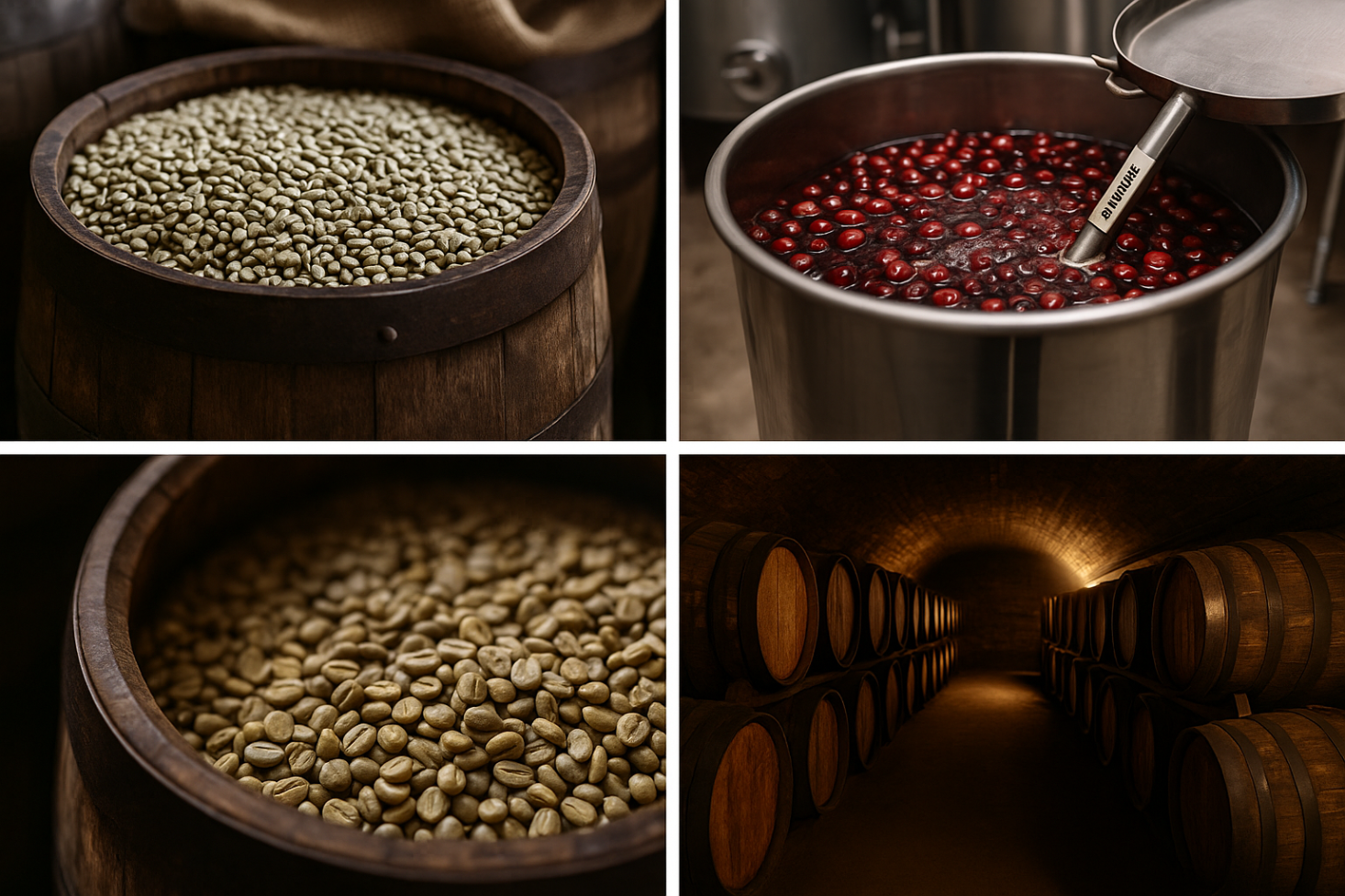
“Rum-style processing” usually means either barrel-aging green coffee in ex-rum casks (aroma transfer) or yeast-driven fermentation using rum-oriented S. cerevisiae strains during cherry or depulped stages to steer ester formation under controlled temperature/pH/Brix. By contrast, classic washed, natural, and honey methods rely on native microbiota and drying dynamics to remove mucilage and stabilize the seed, with minimal introduction of exogenous flavor sources or distillers’ yeasts.
Sensory-wise, barrel-aging behaves like aromatic infusion: alcohol mostly evaporates during roasting, leaving molasses, oak, and faint rum notes. Yeast-driven rum fermentations generate endogenous fruity esters and confectionary tones—pineapple/banana esters, toffee, subtle spice. Washed coffees emphasize clarity and acidity; naturals lean into ripe/dried fruit and fermentation complexity; honey processes split the difference with rounded sweetness. Techniques like carbonic maceration, double anaerobic, or thermal shock also modulate biochemistry, yet remain centered on coffee’s intrinsic matrix, whereas rum-style approaches lean more on sugarcane/distillation-inspired pathways.
On production risks, barrel-aged lots can shift moisture, density, and heat transfer, demanding roast curve adjustments (charge temp, gas, airflow) to avoid uneven drying. Yeast-inoculated rum fermentations require strict hygiene, sealed vessels, and defined endpoints to prevent volatile acidity or reductive faults. Traditional washed/natural/honey flows are more standardized but depend heavily on weather and drying infrastructure.
Labeling and governance hinge on transparency: buyers and competitions increasingly allow pre-drying additions or co-fermentations if fully disclosed—clearly stating whether the coffee was barrel-aged, inoculated with distillers’ yeast, or exposed to sugarcane by-products, alongside time/temperature/pH/Brix. For roasters and consumers, rum-style coffees offer high-impact, dessert-friendly profiles but rely on batch-level control; traditional methods more reliably express origin–variety–altitude signatures.
In positioning, rum-style processing shines in competition lots, limited releases, and pairing menus. Core lineup and terroir education often favor washed/natural/honey for consistency and typicity. Brands can frame rum-style coffees as an experimental/interpretive series, while maintaining clear process disclosure and a stable baseline to keep the portfolio’s sensory map coherent.